Show Mobile Navigation
Powered by Blogger.
WOW
Showing posts with label WOW. Show all posts

Thursday, 4 December 2014

Patrick Dougherty’s Twig Sculptures

Unknown - Thursday, December 04, 2014
North Carolina-based artist Patrick Dougherty has gained an international reputation for weaving tree saplings into massive, swirling forms that resemble bird nests as high as 40 feet. His sculptures are temporary, owning to the nature of the materials used, and break down after a year or two in the wild.

A post-graduate in Hospital and Health Administration, Patrick started studying art history and sculpture at the University of North Carolina, where he began learning about primitive techniques of building, and applying his carpentry skills with his love of nature started to experiment with tree saplings as construction material. 

His first artwork was his house. Collecting fallen branches, rocks and old timber, Dougherty built a villa where he still lives with his wife and son. Incidentally, his house is his only permanent work. Over the last thirty years, he has built over 230 of these works, that have been seen worldwide---from Scotland to Japan to Brussels, and all over the United States.

patrick-dougherty-7
patrick-dougherty-2
patrick-dougherty-4
patrick-dougherty-5

patrick-dougherty-6

Tuesday, 14 October 2014

The Impossible Railroad

WTH - Tuesday, October 14, 2014
At the turn of the 20th century, during the great era of railways, each city on the western seaboard of the North American continent needed a fast and reliable supply line from the east to ensure growth and prosperity. San Diego was a small port city at that time and business pioneers decided that for the city to grow, it they needed a direct link connecting with El Centro to the east, to supplement the supply line from its larger, northern neighbor, Los Angeles. The San Diego and Arizona Railroad was proposed.

The builders soon realized that the rail link to El Centro presented massive engineering challenges. Conditions were harsh and the treacherous mountain ranges were near impassable with gigantic boulders, deep valleys and numerous ridges and canyons. The prospects were so hopelessly against them, that it became known as "the Impossible Railroad", a name made more apt by the hostile desert climate, with temperatures in the summer soaring to over 110 degrees Fahrenheit.

san-diego-arizona-railroad

It took the construction of 17 tunnels, ranging in length from 290 feet to half a mile, and 20 trestles to complete the most mountainous eleven-mile stretch, but the railroad was finally completed in 1919.
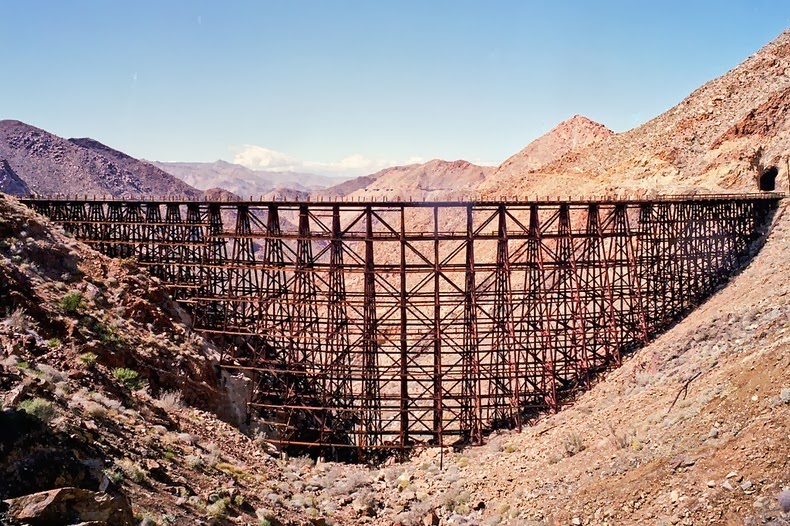
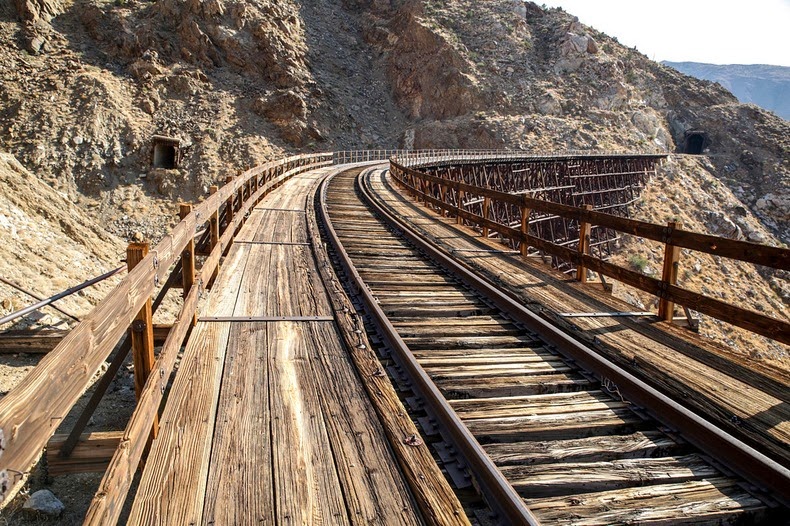
Maintaining the Carrizo Gorge section with its numerous tunnels and trestles was a constant challenge, especially in this earthquake-prone country. When an earthquake collapsed one of the tunnels in 1932, the engineers chose an alternate route around the ridge. But the alternate route necessitated the construction of a bridge over a steep lateral gorge known as the Goat Canyon. The wooden trestle that was constructed here, remains to this day, the longest, tallest curved wooden trestle ever built in the United States. Over 600ft long and 180ft high in the center, the magnificent structure is an engineering marvel that very few has seen.

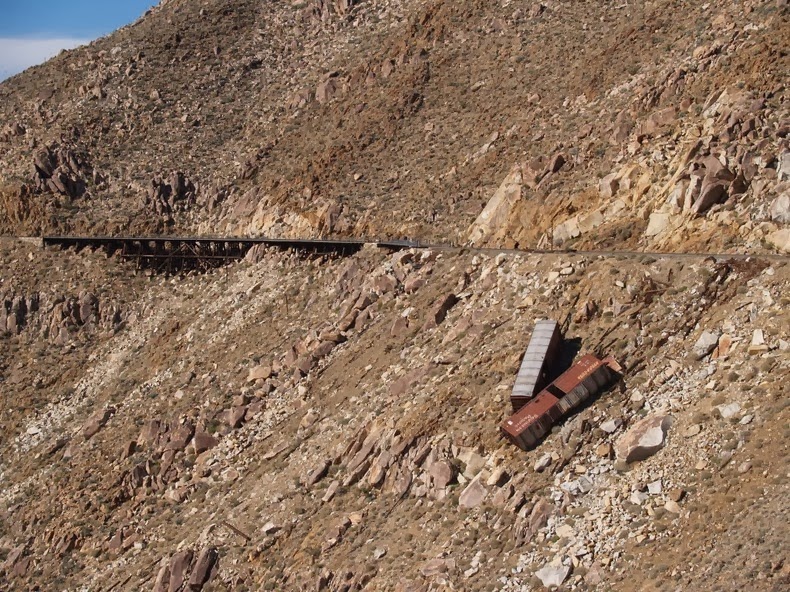
The last passenger train to travel the full length of the railroad left San Diego on Jan.11, 1951, but the railroad continued to ferry freight through the Carrizo Gorge until September 1976 when tropical storm Kathleen washed out the impossible railroad in numerous places. The damage to the section through Carrizo Gorge was so massive that it remains closed to this day. The abandoned railroad now attracts adventurist and railway buffs who try to follow the rails all the way from the high point in Jacumba down the gradient to Ocotillo in a spectacular journey of about 22 miles through a stark desert landscape, dotted with the efforts of railroad engineers to tame this wilderness, an effort that came to nought.

san-diego-arizona-railroad-11
san-diego-arizona-railroad-7
san-diego-arizona-railroad-8
san-diego-arizona-railroad-9
san-diego-arizona-railroad-2
san-diego-arizona-railroad-3
san-diego-arizona-railroad-4
san-diego-arizona-railroad-5
san-diego-arizona-railroad-6
san-diego-arizona-railroad-10
san-diego-arizona-railroad-12
san-diego-arizona-railroad-13
san-diego-arizona-railroad-14
san-diego-arizona-railroad-15
san-diego-arizona-railroad-16
san-diego-arizona-railroad-17
san-diego-arizona-railroad-18
A scale model of the Goat Canyon trestle at San Diego Model Railroad Museum. Photo credit
san-diego-arizona-railroad-21
A model of the Goat Canyon trestle at San Diego Model Railroad Museum. Photo credit
san-diego-arizona-railroad-20
san-diego-arizona-railroad-22

Monday, 13 October 2014

Seven Mile Bridge in Florida

MY GID - Monday, October 13, 2014
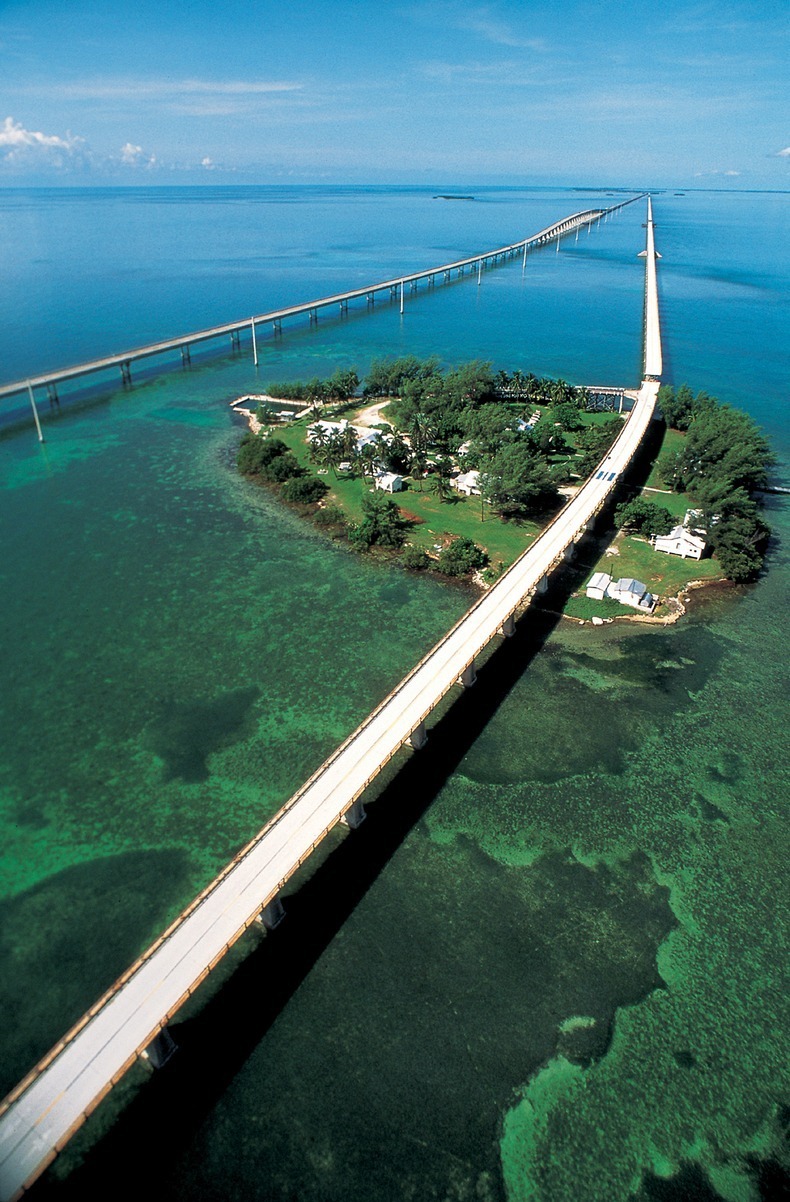
The Seven Mile Bridge is an iconic bridge in the Florida Keys of United States, stretching out into the open sea, connecting Knight's Key in the Middle Keys to Little Duck Key in the Lower Keys. At the time of its completion in 1982, it was the longest continuous concrete segmental bridge in the world, and is currently one of the longest bridges in America.

Seven Mile Bridge actually consist of two bridges in the same location. The older bridge, originally known as the Knights Key-Pigeon Key-Moser Channel-Pacet Channel Bridge, was constructed from 1909-1912 as part of the Overseas Railroad. After the railroad sustained considerable damage during the Labor Day Hurricane of 1935, the bridge was refurbished for automobile use only. Dismantled tracks was recycled, painted white, and used as guardrails. It had a swing span that opened to allow passage of boat traffic, near where the bridge crosses Pigeon Key - a small island that once served as the work camp for the Florida East Coast Railway. When Hurricane Donna in 1960 inflicted further damage, decision to construct a new bridge was made.

sevenmile-bridge-florida-5

A new, wider and sturdier Seven Mile Bridge was built right next to it from 1978 to 1982. When that happened, the original Seven Mile Bridge was nudged out of Florida’s transportation system. The vast majority of the original bridge still exists, used as fishing piers and access to Pigeon Key, but the swing span over the Moser Channel of the Intracoastal Waterway has been removed.

The total length of the new bridge is just under seven miles at 6.79 miles (10.93 km), and is shorter than the original. Each April the bridge is closed for approximately 2.5 hours on a Saturday and a "fun run," known as the Seven Mile Bridge Run, of 1,500 runners is held commemorating the Florida Keys bridge rebuilding project. The event began in 1982 to commemorate the completion of a federally funded bridge building program that replaced spans that oil tycoon Henry Flagler constructed in the early 1900s to serve as a foundation for his Overseas Railroad.

The old bridge is still a popular spot with both locals and tourists, but it’s slowly falling apart. Salt water and storms are eroding the bridge faster than the state can afford to repair it. Much of the bridge is now closed – only a 2.2 mile section of the Old Seven Bridge is still open to pedestrians and cyclists.
Two years ago, a nonprofit community group called “Friends of Old Seven” was formed to try to preserve, and if possible, repair the bridge. The Florida Department of Transportation, which owns the bridge, cannot afford to sink a lot of money into the bridge’s upkeep, but is still willing to donate half of the $18 to $20 million required to repair the bridge. The community is now working hard to put up the other half.

sevenmile-bridge-florida-11
sevenmile-bridge-florida-2
sevenmile-bridge-florida-13
sevenmile-bridge-florida-14
sevenmile-bridge-florida-1
sevenmile-bridge-florida-4
sevenmile-bridge-florida-6
sevenmile-bridge-florida-12
sevenmile-bridge-florida-8
sevenmile-bridge-florida-9
sevenmile-bridge-florida-10

Sources: Wikipedia, WLRN

Terrifying Glass-Bottomed Bridge Opens in China

MY GID - Monday, October 13, 2014
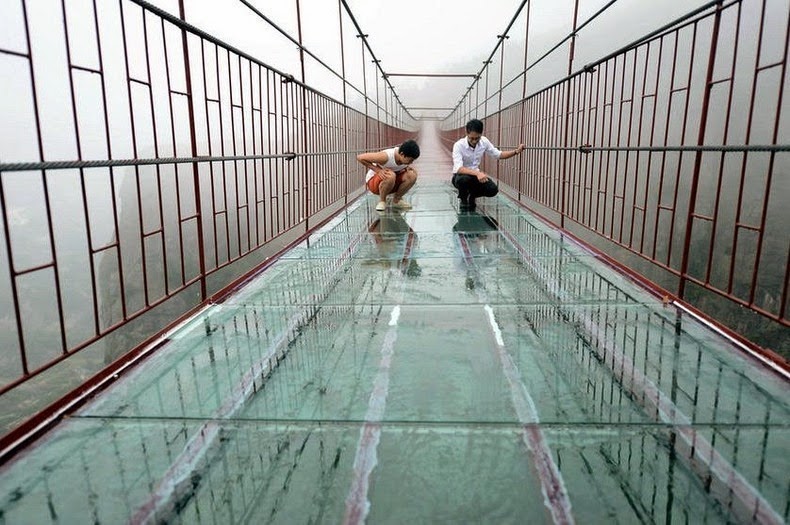
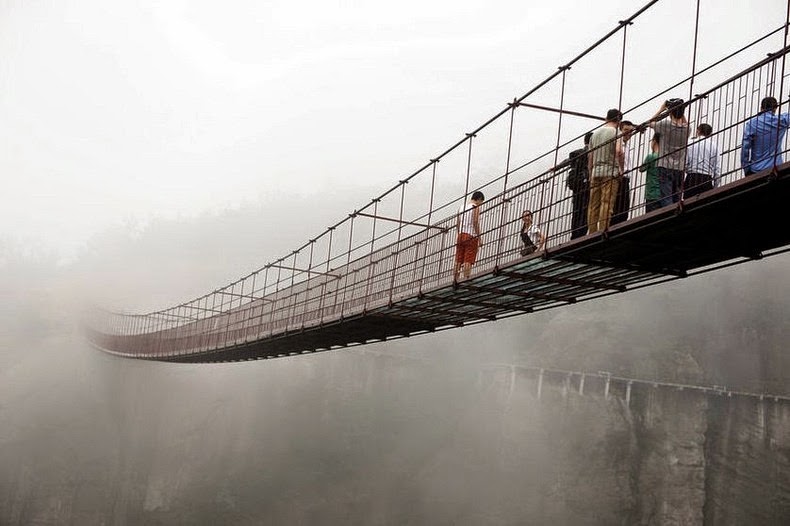
China’s latest attraction is a glass-bottomed suspension bridge that straddles two rocky peaks, 300 meters apart, in Pingjiang county, in the province of Hunan, southern China. The bridge hangs 180 meters above ground, and actually sways with the wind, as if the glass bottom wasn’t terrifying enough. If anyone becomes paralyzed with fear, specially trained staff is available who will encourage and coax fear-stricken tourist to make the journey across.
“We have had a few people say it’s too scary but I have pointed out that if they feel scared, they should think about the person that has to clean underneath. That usually gets people moving,” a spokesperson told Metro.

The new glass bridge joins another vertigo inducing attraction – the glass-bottomed cliff-side pathway in Zhangjiajie, China, perched 1,900 meters above sea level, on the side of the Tianmen Mountain.
glass-skywalk-2
glass-skywalk-1
glass-skywalk-7
glass-skywalk-3
glass-skywalk-5
glass-skywalk-6

glass-skywalk-4

Friday, 10 October 2014

Overloaded Vehicles Only in China

MY GID - Friday, October 10, 2014
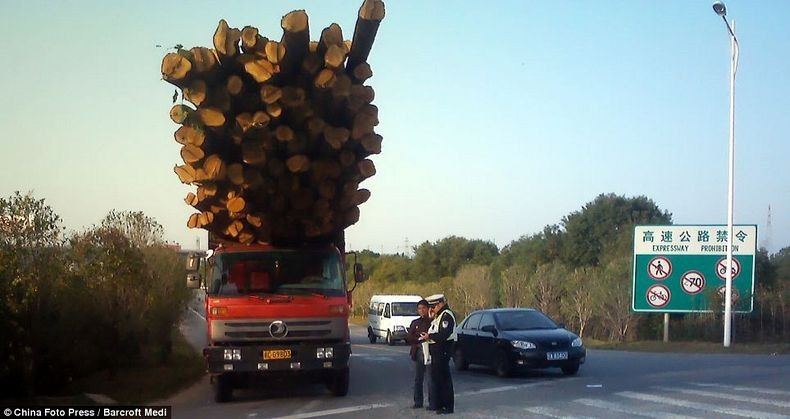
A collection of snaps, mostly taken on the highways of China and published by China Foto Press, reveal drivers who load up their vehicles far beyond their limits as they go about their daily business. These pictures show ridiculously heavy trucks, bikes and tractors with goods piled up to 20 feet above their heads, leaning at unusual angles under the load.

"Highway and bridge tolls in China are too high for transportation companies," said Cui Zhongfu, secretary-general of the China Federation of Logistics and Purchasing. "Sometimes, they can account for as much as 20 percent of the total expense." Therefore, many companies carry too much freight to try to make trips more profitable and compete with rivals.

overloaded-vehicles-china-10

Overloading is a serious problem in China and a hazard for other vehicles and pedestrians. According to authorities, 80 percent of trucks are overloaded. These vehicles have been damaging the country's crumbling highways and collapsed many bridges in the past.

For months, a bridge over the Qiantang River in Hangzhou, that was designed for vehicles weighing only 30 tons and trailers weighing 55 tons, was abused by truckers carrying loads in excess of 100 tons. The bridge finally gave away in July 2011, when a 129-ton truck tried to cross it. In the same month, a bridge in Yancheng, Jiangsu province and another 301-meter steel-arch bridge in Wuyishan, Fujian province, collapsed. Both bridges had been built about 10 years ago.

China has about 660,000 bridges, the most of any country in the world. But each year, more than a dozen of them collapse. Overloading is one of the many reasons of bridge failure.

overloaded-vehicles-china-11
overloaded-vehicles-china-1
overloaded-vehicles-china-2
overloaded-vehicles-china-3
overloaded-vehicles-china-5
overloaded-vehicles-china-6
overloaded-vehicles-china-7
overloaded-vehicles-china-8
overloaded-vehicles-china-9
overloaded-vehicles-china-12
overloaded-vehicles-china-13
overloaded-vehicles-china-14
overloaded-vehicles-china-15
overloaded-vehicles-china-16
overloaded-vehicles-china-17
overloaded-vehicles-china-4
overloaded-vehicles-china-18
overloaded-vehicles-china-19
overloaded-vehicles-china-20
overloaded-vehicles-china-21

Sources: Dailymail, China Daily
Previous
Editor's Choice