Show Mobile Navigation
Powered by Blogger.
Mystery
Showing posts with label Mystery. Show all posts

Tuesday, 14 October 2014

The Ghostly Remains of the Yacht “Mar Sem Fim”

WTH - Tuesday, October 14, 2014
Mar Sem Fim (“Endless Sea” in English) is a Brazilian yacht that was shipwrecked, sunk and subsequently got frozen in ice in Maxwell Bay of Ardley Cove, Antarctica, about 1,200 kilometers south of tip of South America, in April 7th, 2012. The yacht that belonged to the famed Brazilian journalist and entrepreneur João Lara Mesquita, was manned by four crews who were filming a documentary off the Antarctic coast when the boat capsized. 

Strong winds in excess of 100-kilometer per hour had  tossed the boat from one side to the other “like a bucking bronco in a rodeo,” according to one crew member.

With their vessel trapped in ice, the crew radioed for help and was received by the Chilean navy in the base in Bahia Fildes, in Antarctica. All four researchers were eventually rescued but bad weather delayed the process by two days.

João Lara Mesquita, who was also in the yacht, wrote in his blog:

“Then, with strong winds and high waves, the boat Frei came to us. Our evacuation was epic. Waves of more than 1.5 meters and winds over 40 knots made the boat jump from one side to another, like a bucking bronco. When it got close, each of us … threw ourselves into the arms of three Chilean crew members. Fortunately all went safely.”
mar-sem-fim-14

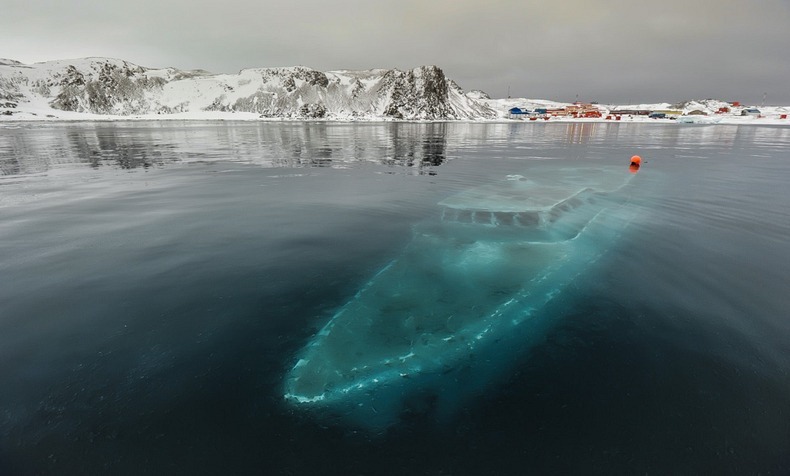
Mar Sem Fim, however, couldn’t be rescued. The near-freezing water that had been tossed over the ship, later froze and then split the hull when it expanded. This phenomena is called compression, and is what was later determined to have been the final blow to the hull of the Mar Sem Fim, sending her to the bottom of the shallow bay.

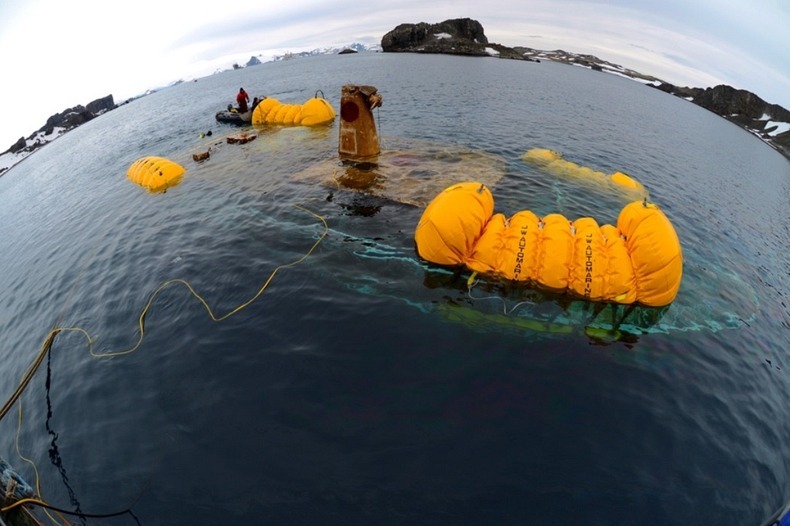
The boat lay in about 30 feet of water, preserved and visible from above, for almost a year, until her recent rescue in early 2013. 

Owner João Lara Mesquita managed to return to the site and when the weather cooperated, sent divers who wrapped strong lines under the hull and attached them to inflated buoys on either side. The buoys were continuously inflated, slowly raising the vessel that had been underwater for almost a year. Once the vessel was surfaced, it was towed back to the shore where the researchers recovered their equipment and the Mar Sem Fim will most likely head for salvage.

The ship was reportedly insured for $700,000, however, the breached hull and damage from being submerged for 10 months would seem to indicate the vessel is beyond repair.

mar-sem-fim-9
Mar Sem Fim in her better days.

The Sinking

mar-sem-fim-13
mar-sem-fim-12
mar-sem-fim-10
mar-sem-fim-11

The Rescue
mar-sem-fim-8
mar-sem-fim-7
mar-sem-fim-6
mar-sem-fim-5
mar-sem-fim-4
mar-sem-fim-2
mar-sem-fim-3

Berkeley Pit, the Pit of Poison

WTH - Tuesday, October 14, 2014
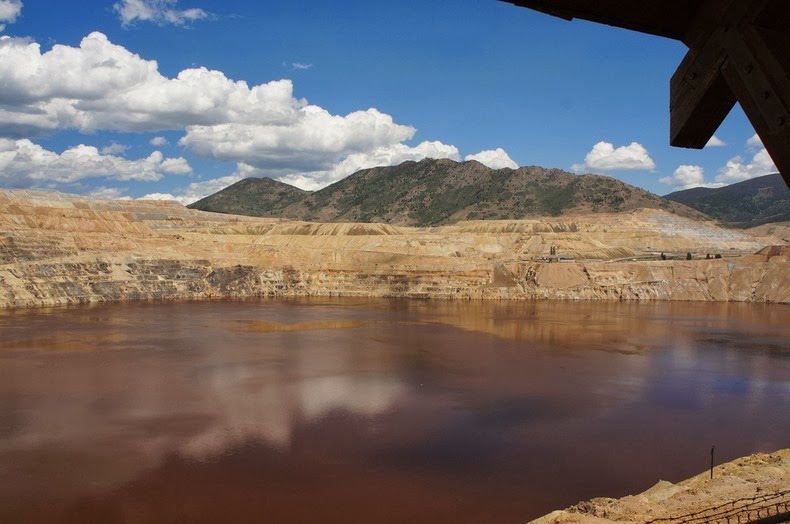
The Berkeley Pit is an abandoned open pit copper mine located in Butte, Montana, United States. It is over a mile long, half a mile wide, and over a third of a mile deep. During its heydays, Berkeley Pit supplied a sixth of the world's copper needs, and during the 27 years of operation approximately 320 million tons of the ore were extracted enough to “pave a four-lane highway four inches thick from Butte to Salt Lake City and 30 miles beyond,” according to Pitwatch.org. The once thriving copper mines of Butte earned the district the title of “the richest hill in the world.”

Today, the pit is filled with nearly 30 billion gallons of highly acidic water laced with toxic chemicals like arsenic, cadmium, zinc, and sulfuric acid that threaten the environment and the water supply of the nearby town of Butte.

berkeley-pit-1

Rich copper deposits were known at Butte since the early 1870’s, although development was delayed due to lack of adequate transportation required to bring the ore to smelters. Without the necessary rail lines and recovery facilities, Butte’s copper ore was sent to Swansea, Wales for processing. By the late 1880s, new railway lines were laid connecting Butte with the Union Pacific out of Ogden, Utah. By the time electricity was discovered, Butte had all the infrastructural components needed to meet the burgeoning demand for copper needed to electrify cities.

From 1892 until 1903, the Anaconda Mine was the largest copper-producing mine in the world accounting for 20% of all US copper production. For nearly 70 years, mining for copper was done by dropping shafts into the earth or boring tunnels through the hills. As price of copper soared, Butte needed more efficient mining techniques, and in 1955, the area introduced open-pit mining in the form of Berkeley Pit.

Within the first year of operation, the Berkeley Pit extracted 17,000 tons of ore per day at a grade of 0.75% copper. Ultimately, about 1 billion tons of material was mined from the Berkeley Pit, of which copper constituted nearly a third. Other metals including silver and gold were also extracted. But steep, continuous declines in copper prices after the Vietnam war led to the eventual shut down of Berkeley operations in 1982.

During mining in Butte, pumps were used to remove surface runoff and groundwater from the mines. When the mine and the pumps were shutdown, the Berkeley Pit began to fill with water rising at about the rate of one foot a month. Today the pit is filled to a depth of about 900 feet or 270 meters.

The pit and its water present a serious environmental problem because the water, with dissolved oxygen, allows pyrite and sulfide minerals in the ore and wall rocks to decay, releasing acid. When the pit water level eventually reaches the natural water table, estimated to occur by around 2020, the pit water will reverse flow back into surrounding groundwater, polluting into Silver Bow Creek which is the headwaters of Clark Fork River. An example of a disaster to come happened in 1955 when a flock of migrating snow geese landed in the Berkeley Pit, killing at least 342 of them.

But in the same year the birds died, a chemist studying the water composition of the pit discovered a robust single-celled algae known as Euglena mutabilis thriving in the toxic waste of the Berkeley Pit. Over the next few years, over 40 different species of organisms were discovered in the pit. Intense competition for the limited resources caused these species to evolve the production of highly toxic compounds to improve survivability – some of the compounds isolated from these organisms have shown to fight against cancer cells.

Berkeley Pit is currently just another tourist attraction. There's a small museum, gift shop and a viewing platform located above the water.

berkeley-pit-6
berkeley-pit-8
berkeley-pit-7
berkeley-pit-9
berkeley-pit-3
berkeley-pit-4
berkeley-pit-5

Lady Of The Lake: The Ghostly Remains of a B-29 Superfortress

WTH - Tuesday, October 14, 2014
The “Lady of the Lake” is what remains of a B-29 weather reconnaissance aircraft that rests in the middle of an Alaskan lake near Eielson Air Force Base.

The aircraft formerly belonging to Eielson's 58th WRS. In 1957, many of the B-29s were replaced by B-50s, a larger version of the B-29. Although the two airplane models looked alike, most parts were not interchangeable. After World War II, many B-29s were stripped of all their useful parts, so that they could be recycled as production of new parts were stopped. By the time the B-50s arrived, parts cannibalization on B-29s was standard practice, just to keep the remaining planes of the fleet flying.

The “Lady of the Lake” was one such unfortunate aircraft. With all the useful parts removed, and with no chance of replacement, the plane was removed from the active aircraft inventory. At that time, almost all of the flights originating out of Eielson AFB were reconnaissance flights traveling over open water, either over the Arctic Ocean, or the North Pacific Ocean. It was decided that the grounded B-29 be used for open water extraction practice.

lady-of-the-lake-1

The plane was hauled out to its present location - a gravel pit off Transmitter Road - via the railroad, and set up in a shallow pond for training purposes. Unfortunately, rain water collected in the pool around the aircraft forming a small pond. Soon the water level became too high to continue the extraction training, and the plane was abandoned in place, where it subsequently became known as “The Lady of the Lake”.

Over the years, a certain mystic rose around the plane, and many different theories came about as to its origins. According to a running rumor, the aircraft was practicing touch-and-go landings when the front landing gear of a B-29P buckled, sending the temporary duty aircraft careening across the Eielson runway into a snowbank. Towing operations damaged the aircraft even more, and base officials decided to condemn the aircraft and strip it of usable parts. As the story goes, several years later the B-29 was hauled to a gravel pit where a lake formed around the dilapidated aircraft.

This story is not true. According to Air Force records, the plane broke down in September 1954 and was declared a permanent loss due to wear and tear on November 15 the same year. When it was towed to its present location is unknown.

lady-of-the-lake-3
lady-of-the-lake-5
lady-of-the-lake-6
A B-29 Superfortress in flight. Photo credit

Monday, 13 October 2014

Cocoon of the Urodidae Moth

MY GID - Monday, October 13, 2014
The Amazonian moth belonging to the family of Urodidae weaves one of the strangest and most beautiful cocoons in the insect world. Unlike other cocoons that completely enclose the pupa in silk, in which to complete the metamorphosis process, Urodidae cocoons have a coarse open mesh design with an exit at the bottom, and hangs like a pendulum on a long thread of silk from the underside of a leaf.

These caterpillars largely inhabit regions of the world that see significant rain, like the Amazon rainforest. The mesh like structure of the cocoon allows rainwater to flush through the cocoon, rather than fill it. Since the pupae breathe throughout their encapsulation in the cocoon, it puts them at risk of drowning if water is not allowed to escape. The long string of silk, on the other hand, helps protect it from invading ants. The chute at the bottom of the cocoon provide an escape for the moth once it begins to emerge. The cocoon itself is bright orange colored and one of the most beautiful.

urodidae-cocoon-5
urodidae-cocoon-4
urodidae-cocoon-1
urodidae-cocoon-3
urodidae-cocoon-2
Sources: Sunnyscope / Pictures: Peru Nature via Reddit

Thursday, 2 October 2014

The Beautiful Fukang Meteorite

MY GID - Thursday, October 02, 2014
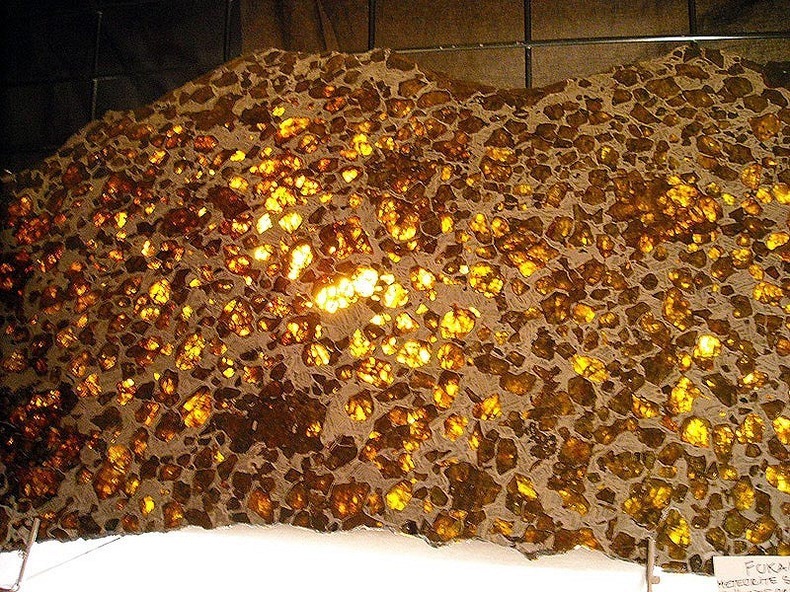
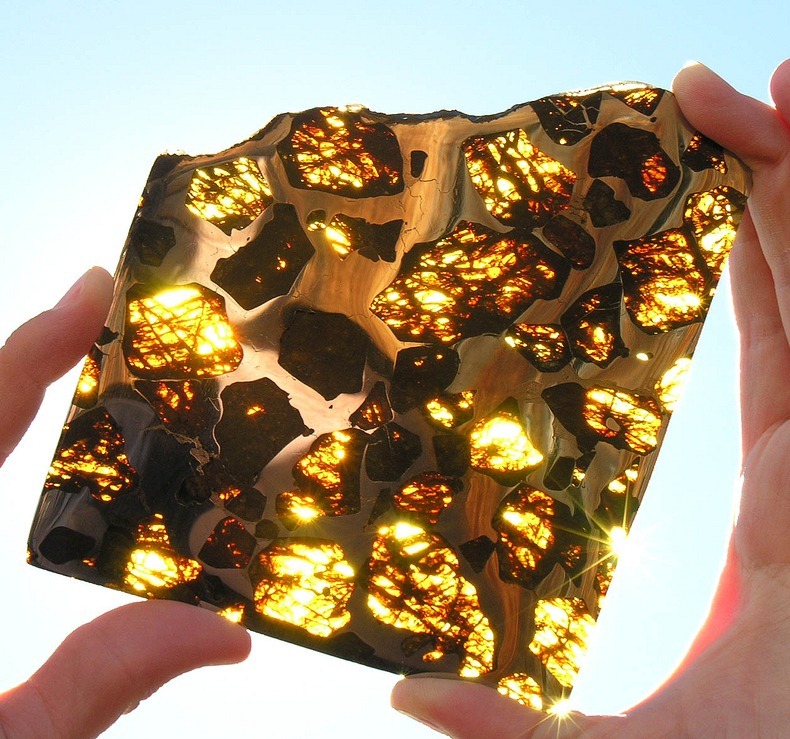
The Fukang meteorite, believed to be some 4.5 billion years old, which is as ancient as Earth itself, was unearthed near a town of the same name in China, in 2000. It is a pallasite, a type of meteorite with translucent golden crystals of a mineral called olivine embedded in a silvery honeycomb of nickel-iron. It’s a gorgeous meteorite, and possibly the most stunning extraterrestrial piece of rock man has ever seen.

The Fukang meteorite was found by a hiker. The man had often stopped and had lunch on this giant rock, and he always wondered what the metal and crystals were. He finally took a hammer and chisel and broke some pieces off, which he sent to the USA to confirm that it was a meteorite.

The original meteorite weighted just over a thousand kilogram, but the rock was so brilliant that everybody wanted a piece of it. Since then it has been divided into dozens of thin slices and auctioned or distributed around the world.

fukang-meteorite-9

A total of thirty-one kilograms of specimen is on deposit at University of Arizona. Marvin Kilgore of the University of Arizona's Southwest Meteorite Centre holds the largest portion weighing at 420 Kg. In 2008, this piece was expected to fetch $2 million at an auction at Bonham's in New York, but unfortunately, the prospective bidders were more impressed with a couple of pieces of 130-million-year-old fossilized dinosaur’s dung that day, which sold at more than twice the estimate.

According to Bonhams, pallasites are composed of approximately 50 per cent olivine and peridot crystals and 50 cent nickel-iron, and thought to be the relics of forming planets. They apparently make up less than one per cent of meteorites. They are believed to originate from deep inside intact meteors created during the formation of the solar system about 4.5 billion years ago and very few specimens are thought to have survived their descent through Earth's atmosphere.

fukang-meteorite-2
fukang-meteorite-1
fukang-meteorite-3
fukang-meteorite-4
fukang-meteorite-5
fukang-meteorite-6
fukang-meteorite-10
Photo credit: unknown

Petoskey Stones of Michigan

MY GID - Thursday, October 02, 2014
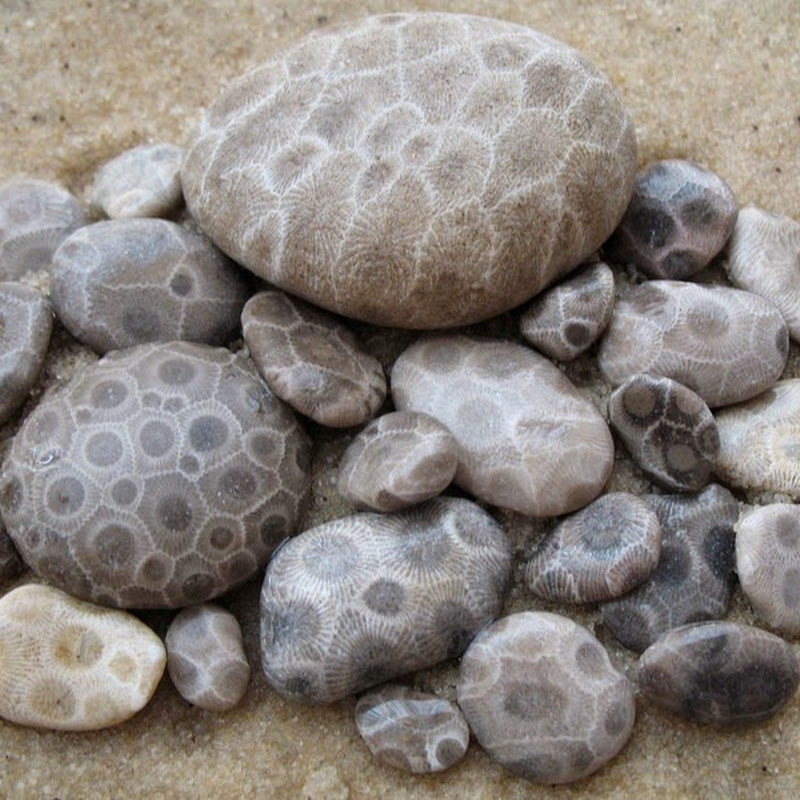
Petoskey stones are composed of fossilized skeletons of Hexagonaria percarinata, a type of coral from coral reefs that once covered all of what is now the state of Michigan, the USA, during the ancient Devonian period, some 350 million years ago. The stones were formed as a result of glaciation, in which sheets of ice scrapped the bedrock, picking up fragments, and then grinding off their rough edges and depositing them in the northwestern portion of Michigan's lower peninsula. 

Basically, Petoskey stones are just chunks of coral reef, and when dry the stone resembles ordinary limestone but when wet or polished, the distinctive mottled pattern of the six-sided coral fossils emerges. This prehistoric fossil is found across the state of Michigan along lakeshores and rivers in sediments commonly called the Traverse group. Since 1965, the Petoskey stone is Michigan’s official state stone.

petoskey-stones-4

Over 350 million years ago during the Devonian period, Michigan was quite different. Geographically, the region was located near the equator and covered by a warm, shallow, saltwater sea, where the colonial coral hexagonaria percarinata thrived with other marine life in tropical reefs. Then the earth’s plates moved and pushed Michigan north and above sea level. When glaciers came about two million years ago, the land was scraped and the fossils spread across the northern Lower Peninsula. The stone was named Petoskey because they are found in great abundance in the Petoskey area.

The name Petoskey comes from “Petosegay”, the son of an 18th century Ottawa chief, and it means “rays of dawn” or “sunbeams of promise.” The city of Petoskey was also named after the same person. Some say, the coral pattern in the stone looks like sun rays radiating from small suns.

Hexagonaria percarinata consists of tightly packed, six-sided corallites, which are the skeletons of the once-living organism. At the center of each corallite was the mouth, surrounded by tentacles that were used for gathering food and drawing the food into the mouth. This dark spot, or the eye of the corallite, has been filled with silt or mud that petrified after falling into the openings. Calcite, silica and other minerals have replaced the original soft tissues, called polyps, in each cell.

Petoskey stones can be found from the shores of Traverse City, north to the Charlevoix and Petoskey area, and across the state to Alpena, but the most popular place to hunt for them is at Lake Michigan beach. Spring is a good time to look for the stone after the ice has melted and uncovered specimens that they’ve pushed against the shore.

petoskey-stones-2
petoskey-stones-3
petoskey-stones-1
petoskey-stones-5

Cemani: A Rare Chicken Breed That is Black Inside Out

MY GID - Thursday, October 02, 2014
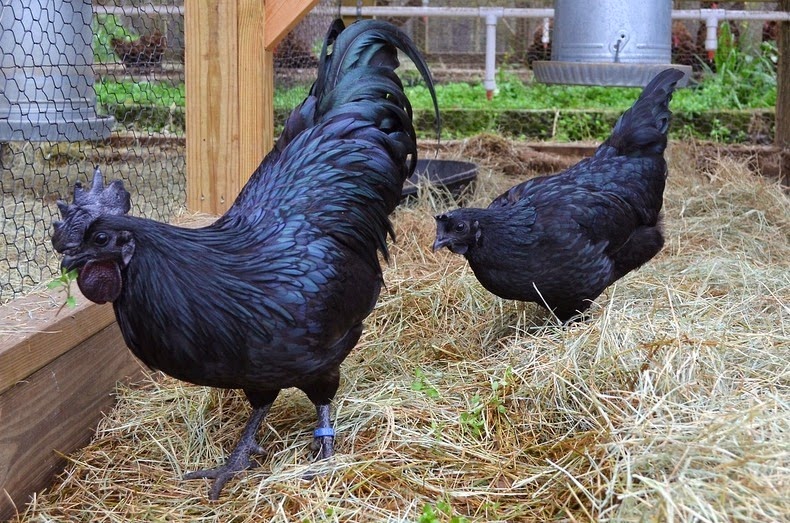
Black is not an uncommon color in the animal world; bears are black, gorillas are black, there are breeds of dogs and cats that are black. But this Indonesian chicken breed known as Ayam Cemani takes ‘black’ into an entirely different realm. The black color of Ayam Cemani is not limited to its feathers – the color is all over and even on the inside. 

Everything about this chicken is black – skin, beak, plume, tongue, legs, toe nails, even its meat, bones, and organs. Even bone marrow is black. Their blood, although not black, is very dark colored. Ayam Cemani is so spectacular and exotic that it is referred to as the “Lamborghini of poultry.”

The word ‘Ayam’ means ‘chicken’ in Indonesian, and ‘Cemani’ translates to ‘completely black’ in Javanese. This exotic breed originated from Java in Indonesia. They were introduced to Europe in 1998 by a Dutch breeder, where they drew considerable interest amongst poultry enthusiasts due to its looks and genetic make up. Ayam Cemani is one of the most expensive chickens in the world with a single bird costing up to $2,500.

ayam-cemani-1

Ayam Cemani get their black coloring from a generic trait known as ‘fibromelanosis’, that promotes the proliferation of black pigment cells. The gene that causes fibromelanosis is a mutation that existed in Asia more than 800 years ago. The mutation made its way to other chicken variety, such as the Swedish Black Hen, or Svart Hona, which has the same fibromelanistic traits as the Ayam Cemani, and hence, as black as the Indonesian breed.

In Asia, Ayam Cemani are highly regarded because their meat is believed to have mystical powers. Their meat is thought to be higher in Iron, therefore beneficial to women before and after childbirth. Birds are sometimes sacrificed during childbirth believing fortune will come to the labouring mother. The chicken is also sacrificed on other special occasions, as it is thought to bring luck. Some Asian people believe that eating this chicken will ease their conscience, and their crowing brings prosperity.
The chicken lays cream-colored eggs – the only part of Ayam Cemani that is not black. However, being poor sitters, they don’t roost and therefore the only way to hatch eggs is to incubate.


ayam-cemani-7
ayam-cemani-2
ayam-cemani-3
ayam-cemani-4
ayam-cemani-5
ayam-cemani-6
ayam-cemani-8

Previous
Editor's Choice