Show Mobile Navigation
Powered by Blogger.
Amazing
Showing posts with label Amazing. Show all posts

Thursday, 4 December 2014

Pearl-Qatar, A Luxurious Artificial Island

Unknown - Thursday, December 04, 2014
The Pearl-Qatar in Doha, Qatar, is a luxurious residential complex that is being developed on an artificial island, off the coast of Doha’s West Bay. The 4-square-km island created on reclaimed land has 32 kilometers of new coastline lined with private villas, dozens of apartments towers and hundreds of homes, along with luxury hotels and opulent stores and restaurants. As of spring 2012, more than 5,000 residents have already moved in. When construction completes by 2015, the island will have room for 41,000. The Pearl-Qatar is one of the most ambitious development project in Qatar, and the first development to offer freehold and residential rights to international clients.

The development’s name “Pearl” refers to the major pearl-diving industry that used to be based on the shallow seabed where the island is being built. Qatar was one of the major pearl traders of Asia before the Japanese introduced cheaper more affordable pearls just before Qatar's oil boom. The island’s design also resemble a string of pearls.

pearl-qatar-10

The Pearl-Qatar’s first phase and gateway to the Island boasts of the world’s longest waterfront luxury retail walkway, the 3.5 kilometer marina-front pedestrian boardwalk “La Croisette”, which is home to international hospitality brands and high-end boutiques. The large Porto Arabia district encompasses 31 apartment towers around a circular lagoon with a central island and a marina with space for 750 boats. 

There are also more than 400 town homes, over 6,000 parking spaces and extensive space for retail stores including a multitude of internationally renowned outlets. These include brands like Giorgio Armani, Hugo Boss, Roberto Cavalli and Elie Saab. There will also be a “Venice-like community” with extensive canal system, pedestrian-friendly squares and plazas and beachfront townhouses. There is even a replica of Venice’s Rialto Bridge.

When the project was first revealed in 2004, the initial cost of constructing the island stood at $2.5 billion. It is now believed the project will cost $15 billion upon completion.


pearl-qatar-2
pearl-qatar-1
pearl-qatar-6
pearl-qatar-7
pearl-qatar-8
pearl-qatar-9

Sunday, 30 November 2014

Exocoetidae: The Fish That Flies

Unknown - Sunday, November 30, 2014
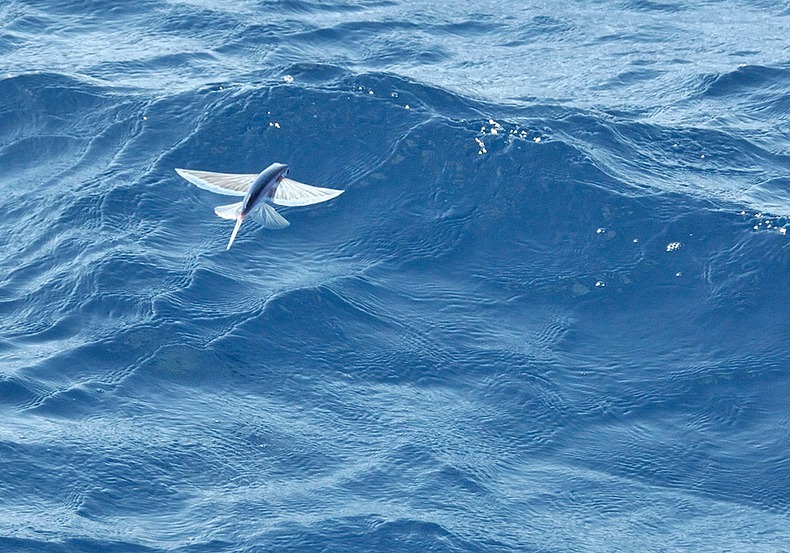
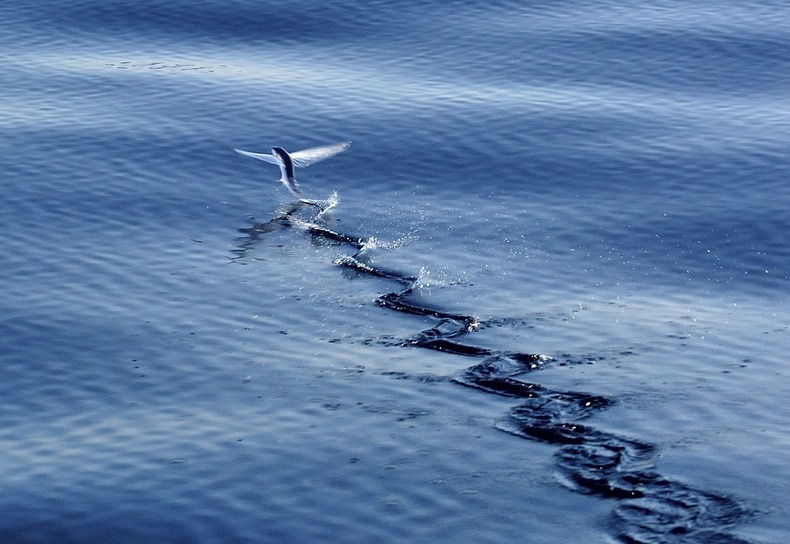
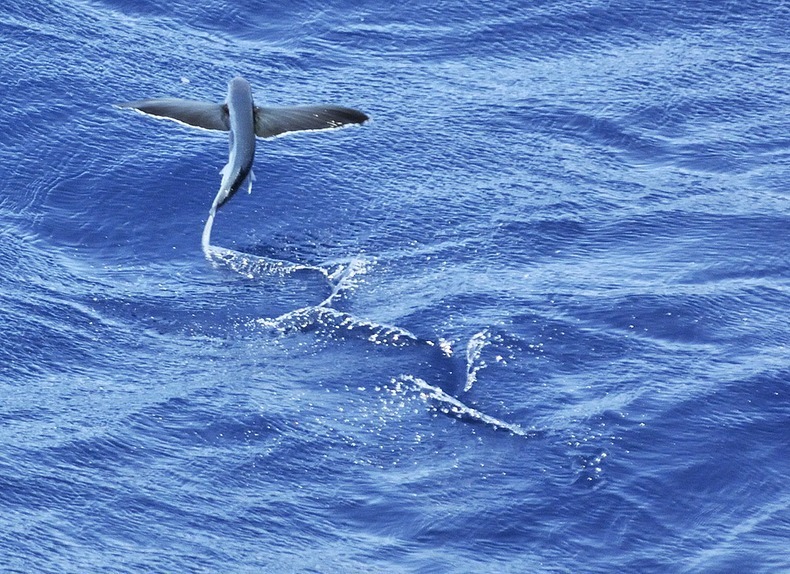
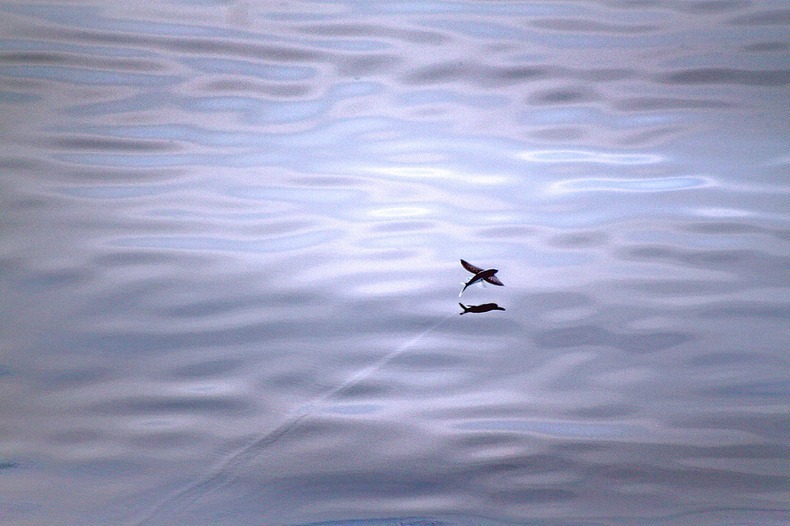
Exocoetidae, commonly called Flying Fish, is a family of fishes aptly named for their ability to emerge out of the water and glide for long distances with their outstretched pectoral fins. Their streamlined torpedo shape helps them gather enough underwater speed to break the surface, and their large, wing-like fins get them airborne. Once in the air, these fishes can glide over considerable distances. Their flights are typically around 50 meters, but some fishes have been recorded to fly up to 200 meters or more. Some species of flying fish have enlarged pelvic fins as well as enlarged pectoral fins, which allows them to fly further than two winged gliders (up to 400 meters), and have far greater maneuverability. These fishes are known as four-winged flying fish.

flying-fish-4

To glide upward out of the water, a flying fish moves its tail up to 70 times per second. It then spreads its pectoral fins and tilts them slightly upward to provide lift. At the end of a glide, it folds its pectoral fins to reenter the sea, or drops its tail into the water to push against the water to lift itself for another glide, possibly changing direction. The curved profile of the "wing" is comparable to the aerodynamic shape of a bird wing. The fish is known to take advantage of updrafts created by air currents to increase its time of flight.
Flying fish are thought to have evolved this remarkable gliding ability to escape predators, of which they have many. Their pursuers include mackerel, tuna, swordfish, marlin, and other larger fish. Unfortunately, this evasive maneuver is not enough to escape the biggest predator on earth – humans.
Flying fish is commercially fished in Asian countries such as Japan, Vietnam and China, including the Caribbean where it’s a coveted delicacy. In Japanese cuisine, the fish is used to make some types of sushi. It is also a staple in the diet of the Tao people of Taiwan. In Barbados, flying fish were threatened by pollution and overfishing, changing the occurrences of flying fish in the waters off of Barbados. This sparked a fishing controversy between Barbados, and Trinidad and Tobago.

flying-fish-3
flying-fish-11
flying-fish-12
flying-fish-1
flying-fish-2
flying-fish-5
flying-fish-6
flying-fish-7
flying-fish-8
flying-fish-9

Thursday, 2 October 2014

Opal – The Most Spectacular Gemstone

MY GID - Thursday, October 02, 2014
Opal is one of the most beautiful of gemstones. These stones can flash every color of the spectrum with a brilliance that can even surpass that of diamond. Precious opal ranges from clear through white, gray, red, orange, yellow, green, blue, magenta, rose, pink, slate, olive, brown, and black. Of these hues, the reds against black are the most rare, whereas white and greens are the most common. 

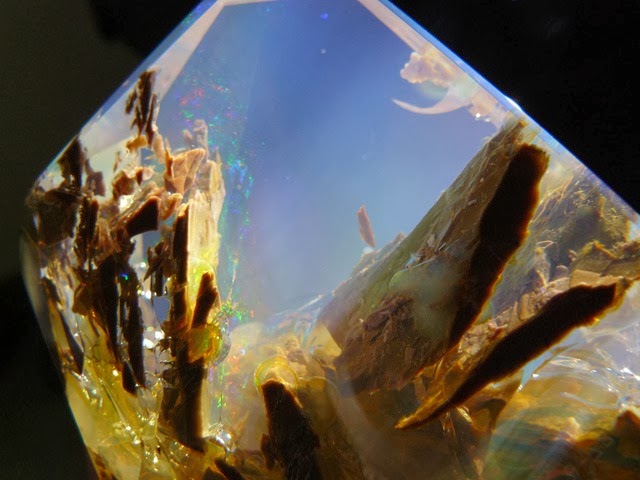
Some rare specimens produce brilliant color flashes when turned in the light. For instance, a new Opal was discovered in the Welo district of Ethiopia recently, that took the gem world by storm. Found in the Welo Amhara Regional State Highland plateau 2.500 – 3.200 meters above sea level, this new gemstone looks like a miniature underwater scene from the ocean when held against the light. Opals such as the Welo Opal can can command prices per carat that rival the most expensive diamonds, rubies and emeralds.

opal-9
The Welo Opal
opal-1
opal-4
opal-5
opal-6
opal-2
opal-11
opal-12
Here is another brilliant Opal – the Fire Opal, also called Mexican fire opals because they are found in the state of QuerĂ©taro in Mexico. It looks like someone put a sunset inside the stone.
opal-3
The Lightning Ridge Black Opal is another stunning example.
opal-7

See more pictures of Opal here.

Mitchell Falls in Australia

MY GID - Thursday, October 02, 2014
Mitchell Falls is a beautiful four-tiered waterfall located in the remote north of the Kimberley Region in Western Australia, about 2,140 kilometers northeast of Perth. It is located within Mitchell River National Park and is one of the park’s main attractions.

Mitchell Falls can be accessed only helicopter or by foot during the dry season when the Gibb River Road is open from around May to November each year. The wet season starts from December and lasts until May during which the Mitchell Plateau area gets an average annual rainfall of some 1,600 mm. Torrential rains make rivers run wild eroding riverbeds and carrying away every thing in their path. As the torrents flood the high country, they fall in stupendous cataracts and waterfalls into deep gorges.

mitchell-falls-6
Photographer: unknown

Like other waterfalls in the tropical regions of Northern Australia, most of the flow of the Mitchell Falls come from rain water during the wet season. The flow would then diminish as the Dry Season wore on. Mitchell Falls usually flow from the wet until anywhere between July to October.

The Mitchell Falls are accessible via a bush walk that takes a couple of hours over rough terrain. The walk is in a remote wilderness area and requires a reasonable level of fitness. A helicopter flight allows you to grasp the extreme ruggedness of the plateau, and is the only way to view many of the waterholes and surrounding area.

mitchell-falls-1
mitchell-falls-2
mitchell-falls-3
mitchell-falls-5
mitchell-falls-7
mitchell-falls-8
Mitchell Falls during the dry season. Photo credit

Wineglass Bay in Australia

MY GID - Thursday, October 02, 2014
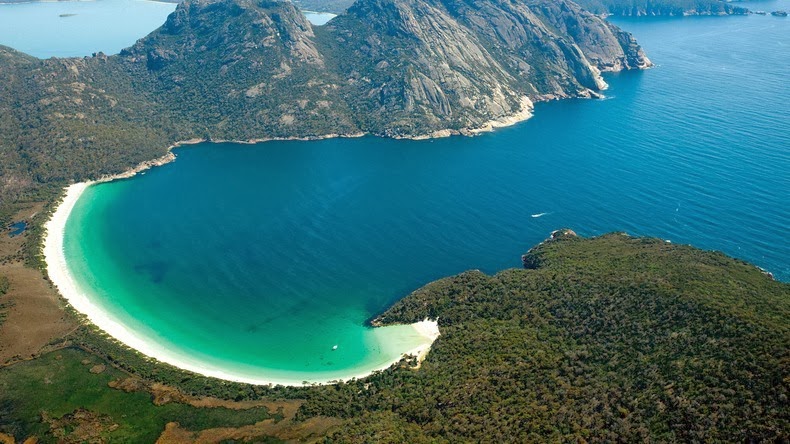
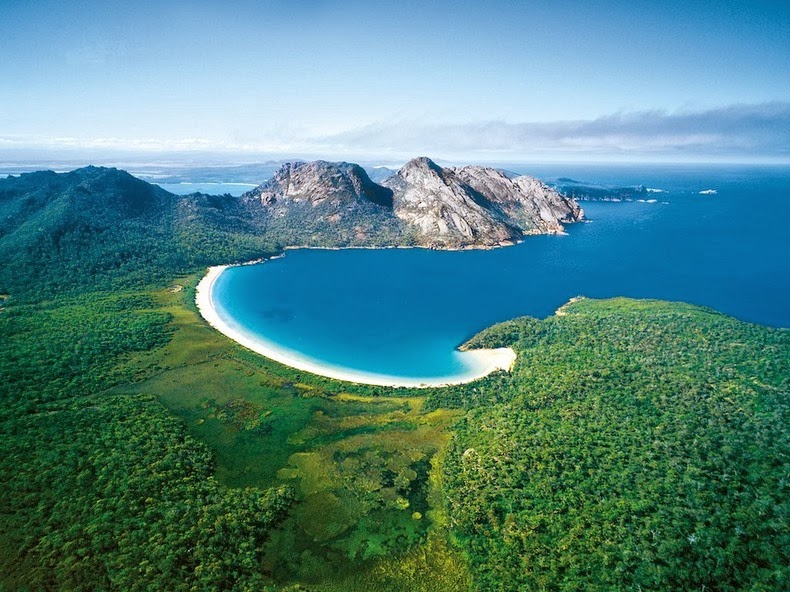
Located on Tasmania’s Freycinet Peninsula, Wineglass Bay is one of the most photogenic beaches in Australia. This crescent-shaped beach of dazzling white sand and sapphire-coloured sea is considered among the top ten beaches in the world.

Wineglass Bay is a good hour’s hike from the Parsons Cove car park, but it’s from the saddle track over the jagged granite peaks called “The Hazards”, that one can have the best view. From this vantage point you can see the beautiful curving, brilliant white sand beach, with a foreground of bright blue water, and background of dense green vegetation.

wineglass-bay-1

The beach itself is 1.7 km long and curves round in a northeast-facing arc. Waves are relatively low averaging 50 cm to 1 m in height and decreasing into the southern corner. They surge up a steep, white sand beach face, with no bar and deep water right off the beach. The beach is backed by a low vegetated dune, which forms the eastern side of the 1.5 km wide isthmus bordered in the west by Hazards Beach. Indigo Creek occasionally drains across the more protected southern end of the beach, with boats often moored off the corner.

To the south of Wineglass Bay are 20 km of exposed steep, rugged, pink and grey granite shoreline bordered by 100m high Cape Forestier in the north and 60 m high Cape Degerando to the south.
Winglass Bay is a great location for fishing, sailing, bushwalking, sea kayaking, rock-climbing, or simply soaking up the spectacular coastal scenery. With secluded sandy beaches, luxurious eco-lodges, it has become a favourite honeymoon destination for couples to escape and relax away from the rest of the world.

wineglass-bay-7
wineglass-bay-8
wineglass-bay-5
wineglass-bay-2
wineglass-bay-3
wineglass-bay-4

Sources: BeachsafeWikipedia

The Cannonball Tree

MY GID - Thursday, October 02, 2014
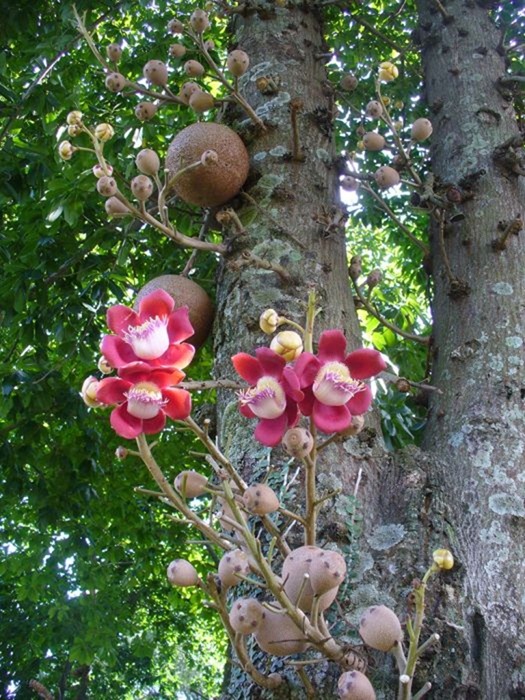
The Cannonball Tree (scientific name: Couroupita guianensis) is a spectacular South American tree to be planted in subtropical and tropical botanical gardens throughout the world. The tree got its name from the shape and size of its fruit which resembles a cannon ball. The fruit is large, spherical and woody ranging from 15 to 24cm in diameter. A single tree can bear as many as 200 or 300 fruits.

cannonball-tree (13)

The fruit when mature falls from the tree and cracks open when it hits the ground, often causing the sound of a small explosion. Like coconut palms, the heavy nut is known to fall without notice and can cause serious injury to any victim who may be unfortunate enough to be under.

Although the Cannonball Tree is believed to be native to the tropical forests of north-eastern South America, according to old Indian texts, the tree has been growing in India for the past two or three thousand years at least hence it is possible that it is native to India also.

cannonball-tree (9)
cannonball-tree (2)
cannonball-tree (3)
cannonball-tree (7)
cannonball-tree (5)
cannonball-tree (1)

cannonball-tree (11)
Previous
Editor's Choice