Show Mobile Navigation
Powered by Blogger.
Travel
Showing posts with label Travel. Show all posts

Friday, 31 October 2014

Shilin Stone Forest, China

MY GID - Friday, October 31, 2014
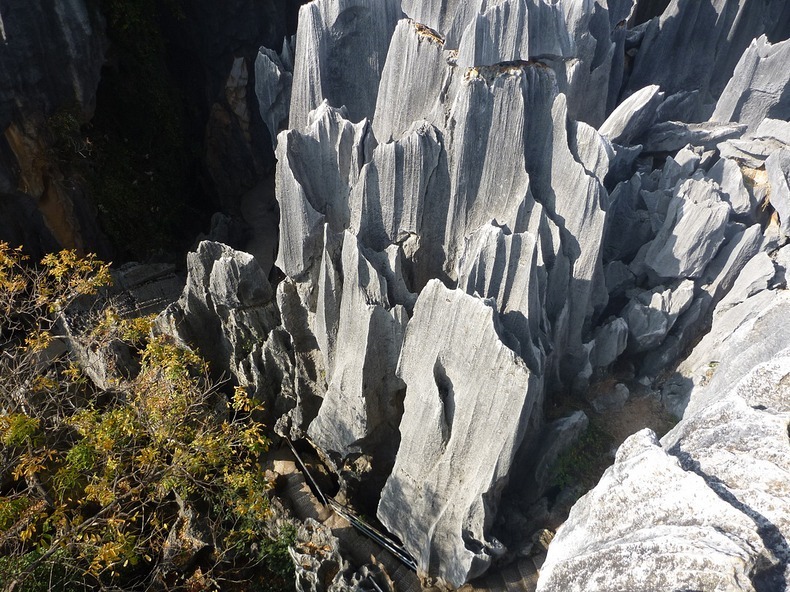
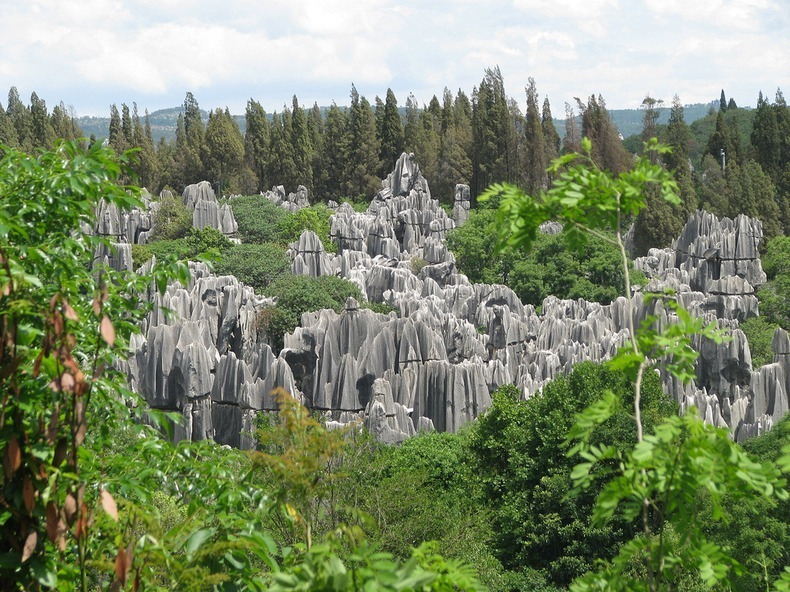
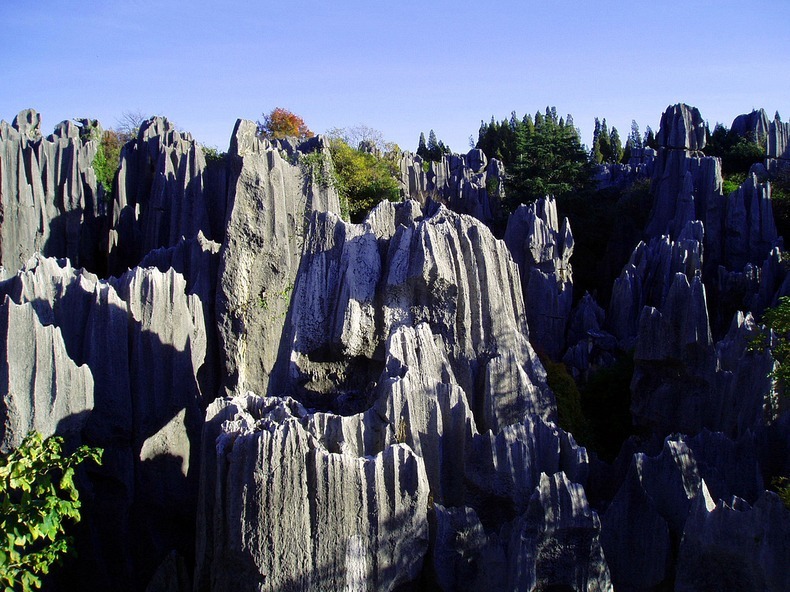
The Shilin Stone Forest is a set of spectacular limestone formations located in Shilin Yi Autonomous County, Yunnan Province, in China, approximately 120 km from the provincial capital Kunming. The tall rocks seem to emanate from the ground like stalagmites, with many looking like petrified trees thereby creating the illusion of a forest made of stone. 

Some of the stone formations are up to 30 meters tall.

Over 270 millions years, abusive geological processes, and erosion by water has carved the limestone into shapes that we see today. The resulting formations are generally known as karst - a German term for the region in Slovenia where the process was first investigated.

shilin-stone-forest-3

The stone forest forms part of the South China Karst region that extends over a surface of half a million square kilometers lying mainly in Yunnan, Guizhou and Guangxi provinces. It represents one of the world’s most spectacular examples of humid tropical to subtropical karst landscapes. 

The Shilin Stone Forest displays superlative karst features and landscapes seen nowhere else in the world, with a wider range of pinnacle shapes than other karst landscapes, and a higher diversity of shapes and changing colours. There are pinnacle-shaped, column-shaped, mushroom-shaped, and pagoda-shaped groups. Since almost all the typical pinnacle karst types can be identified in the Stone Forest, the park is acclaimed internationally the "Museum of Stone Forest karst".

shilin-stone-forest-2
shilin-stone-forest-4
shilin-stone-forest-6
shilin-stone-forest-7
shilin-stone-forest-8
shilin-stone-forest-9
shilin-stone-forest-10
shilin-stone-forest-5
shilin-stone-forest-11
shilin-stone-forest-12
shilin-stone-forest-13

Tuesday, 14 October 2014

The Meandering Alatna River in Alaska

WTH - Tuesday, October 14, 2014
The Alatna River is one of the six federally designated wild and scenic river partially contained within the boundaries of Gates of the Arctic National Park, Alaska. It is called one of the most beautiful rivers in the United States. The Alatna River stems from the central Brooks Range flowing through the Endicott Mountains, passing Circle Lake, the Arrigetch Peaks and Takahula Lake before entering the Helpmejack Hills. 

The last section of the river continues to flow in a SSE direction through the Alatna Hills into its confluence with the Koyukuk River near the small village of Allakaket. The first 40 km of the Alatna are shallow and rocky, followed by 24 km of a continued shallow area with more rapids. The river then mellows out near Takahula and Circle Lake becoming deeper and more meandering while the scenery turns from mountain peaks into hilly boreal forest. According to The Alaska River Guide, this river is 296 km long from the headwaters to Allakaket and 220 km from Circle Lake to Allakaket.

alatna-river-2

The river is very popular for float trips due to its calm flow and wonderful scenery. Float trips usually take from four to fourteen days, depending on put-in spot and pick-up spot, and also weather/river conditions. One common place to put in is Circle Lake, a small lake which is float plane accessible and is located in a beautiful part of the valley. Another place to put in is Takahula Lake, a larger, float-plane accessible lake, further downstream from Circle Lake. Gaedeke Lake is also a possible put in spot, but according to the Alaska River Guide, this upstream section near the headwaters of the river is shallow and rocky making portaging or lining necessary. Most floaters take out at the village of Allakaket.

alatna-river-4
alatna-river-5
alatna-river-6
alatna-river-8
alatna-river-9
alatna-river-1
alatna-river-3

Source: Wikipedia

The Ghostly Remains of the Yacht “Mar Sem Fim”

WTH - Tuesday, October 14, 2014
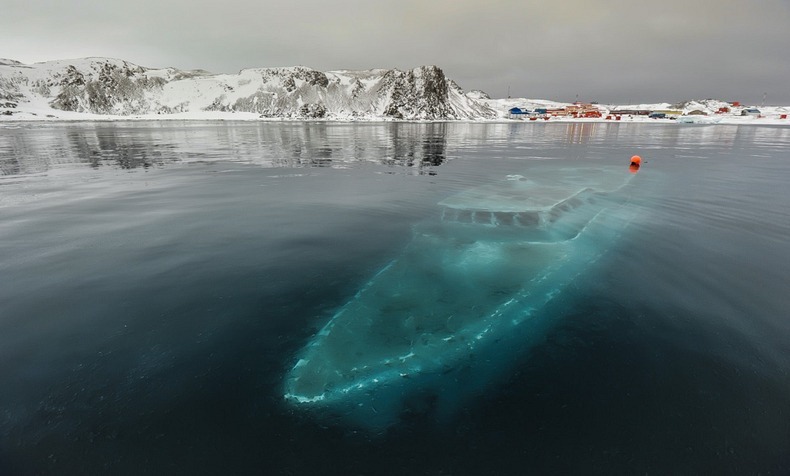
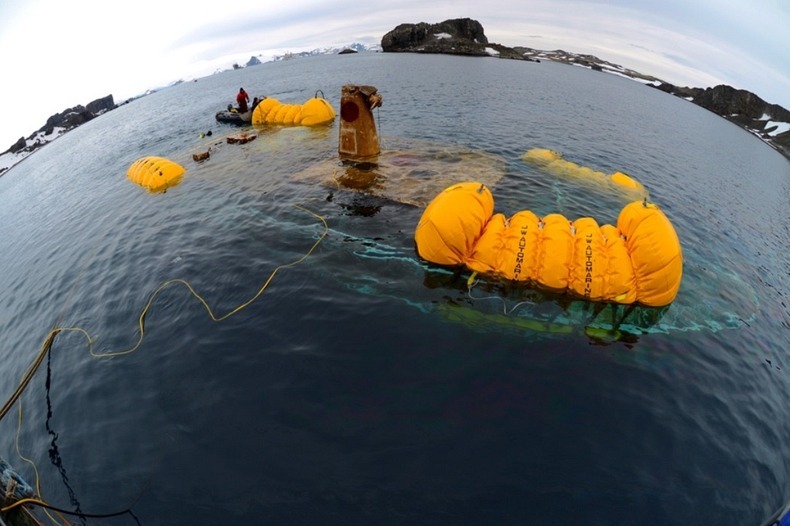
Mar Sem Fim (“Endless Sea” in English) is a Brazilian yacht that was shipwrecked, sunk and subsequently got frozen in ice in Maxwell Bay of Ardley Cove, Antarctica, about 1,200 kilometers south of tip of South America, in April 7th, 2012. The yacht that belonged to the famed Brazilian journalist and entrepreneur João Lara Mesquita, was manned by four crews who were filming a documentary off the Antarctic coast when the boat capsized. 

Strong winds in excess of 100-kilometer per hour had  tossed the boat from one side to the other “like a bucking bronco in a rodeo,” according to one crew member.

With their vessel trapped in ice, the crew radioed for help and was received by the Chilean navy in the base in Bahia Fildes, in Antarctica. All four researchers were eventually rescued but bad weather delayed the process by two days.

João Lara Mesquita, who was also in the yacht, wrote in his blog:

“Then, with strong winds and high waves, the boat Frei came to us. Our evacuation was epic. Waves of more than 1.5 meters and winds over 40 knots made the boat jump from one side to another, like a bucking bronco. When it got close, each of us … threw ourselves into the arms of three Chilean crew members. Fortunately all went safely.”

mar-sem-fim-14

Mar Sem Fim, however, couldn’t be rescued. The near-freezing water that had been tossed over the ship, later froze and then split the hull when it expanded. This phenomena is called compression, and is what was later determined to have been the final blow to the hull of the Mar Sem Fim, sending her to the bottom of the shallow bay.

The boat lay in about 30 feet of water, preserved and visible from above, for almost a year, until her recent rescue in early 2013. 

Owner João Lara Mesquita managed to return to the site and when the weather cooperated, sent divers who wrapped strong lines under the hull and attached them to inflated buoys on either side. The buoys were continuously inflated, slowly raising the vessel that had been underwater for almost a year. Once the vessel was surfaced, it was towed back to the shore where the researchers recovered their equipment and the Mar Sem Fim will most likely head for salvage.

The ship was reportedly insured for $700,000, however, the breached hull and damage from being submerged for 10 months would seem to indicate the vessel is beyond repair.

mar-sem-fim-9
Mar Sem Fim in her better days.

The Sinking

mar-sem-fim-13
mar-sem-fim-12
mar-sem-fim-10
mar-sem-fim-11

The Rescue

mar-sem-fim-8
mar-sem-fim-7
mar-sem-fim-6
mar-sem-fim-5
mar-sem-fim-4
mar-sem-fim-2
mar-sem-fim-3

Chittagong Ship Breaking Yard

WTH - Tuesday, October 14, 2014
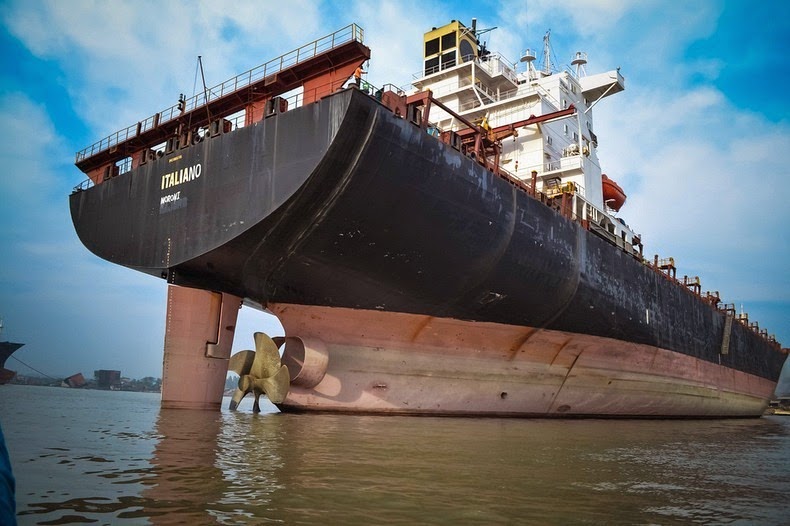
Near the port city of Chittagong in Bangladesh, lies one of the largest ship-breaking yards in the world. It stretches for 18 km along the coast on the Bay of Bengal where more than 200,000 Bangladeshis break down up to 100 ships a year. Working under hazardous conditions, workers rip apart ships with their bare hands and a blowtorch to assist, dissecting the ship bolt by bolt, rivet by rivet. Every piece of metal worth salvaging is carried on to waiting trucks in the shoreline to be carried away to furnaces where it will be melted down and fashioned into steel rods. The steel accounts for half of all the steel in Bangladesh.
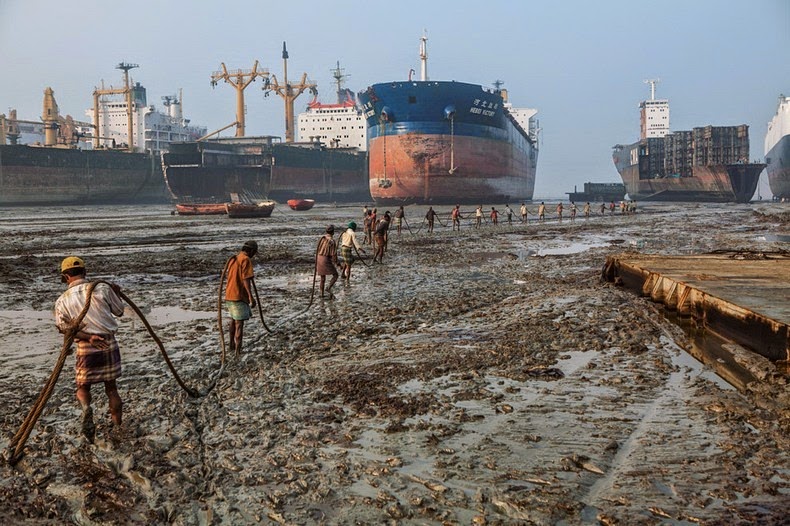
chittagong-ship-breaking-yard-1

The industry, which employs thousands and supplies Bangladesh with most of its steel, began with a cyclone in 1960, when a violent storm left a Greek cargo ship stranded on the shores of Sitakunda in Chittagong. The ship could not be refloated and so remained there for several years. In 1965, Chittagong Steel House bought the ship and with the help of locals had it scrapped. The process took years but the the cheap and resilient labor force, coupled with flat beaches ushered in the start of a new industry for Bangladesh.

The industry grew steadily through the 1980s and, by the middle of the 1990s, the country ranked number two in the world by tonnage scrapped. In 2008, there were 26 shipbreaking yards in the area, and in 2009 there were 40. From 2004 to 2008, the area was the largest shipbreaking yard in the world.

The process begins after a ship-breaker acquires vessels from an international broker who deals in decommissioned ships. A captain who specializes in beaching large craft is hired to deliver it to the breaker’s yard. Once the ship is mired in the mud, its liquids are siphoned out, including any remaining diesel fuel, engine oil, and firefighting chemicals, which are resold. Then the machinery and fittings are stripped. Everything is removed and sold to salvage dealers where they are turned into construction materials, girders, metal sheets and furniture. Nothing goes to waste - from enormous engines, batteries, generators, and miles of copper wiring to the crew bunks, portholes, lifeboats, sinks, toilets, and electronic dials on the bridge.

After the ship has been reduced to a steel hulk, swarms of laborers from the poorest parts of Bangladesh use acetylene torches to slice the carcass into pieces. These are hauled off the beach by teams of loaders, then melted down and rolled into rebar for use in construction.

Ship-breaking is a profitable business in Chittagong. In three to four months the average ship in Bangladeshi yards returns roughly a one-million-dollar profit on an investment of five million, compared to less than $200,000 profit in Pakistan. Cheap labor and poor safety standards allows the profit margin to be kept high.

The workers themselves earn about four dollars per day. In return, they inhale noxious fumes and are vulnerable to electrocution, falling debris and explosions of leftover gas. Many workers have deep, jagged scars, while some have fingers missing and a few are blind in one eye.

chittagong-ship-breaking-yard-2
chittagong-ship-breaking-yard-3
chittagong-ship-breaking-yard-4
chittagong-ship-breaking-yard-5
chittagong-ship-breaking-yard-6
chittagong-ship-breaking-yard-7
chittagong-ship-breaking-yard-8
chittagong-ship-breaking-yard-13
chittagong-ship-breaking-yard-14
chittagong-ship-breaking-yard-15
chittagong-ship-breaking-yard-12
chittagong-ship-breaking-yard-9
chittagong-ship-breaking-yard-10
chittagong-ship-breaking-yard-11
chittagong-ship-breaking-yard-16
Satellite picture showing a part of Chittagong Ship Breaking Yard.

Sources: Nat Geo / Slate / CBSNews

Monday, 13 October 2014

The Langkawi Sky Bridge in Malaysia

MY GID - Monday, October 13, 2014
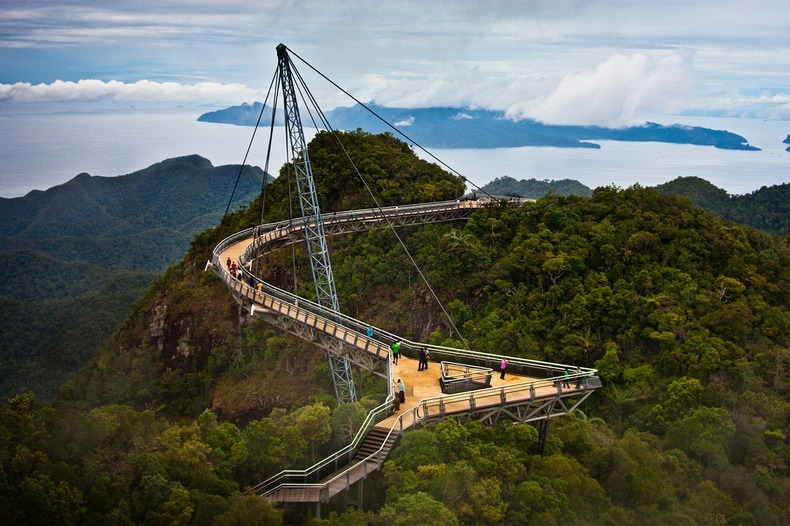
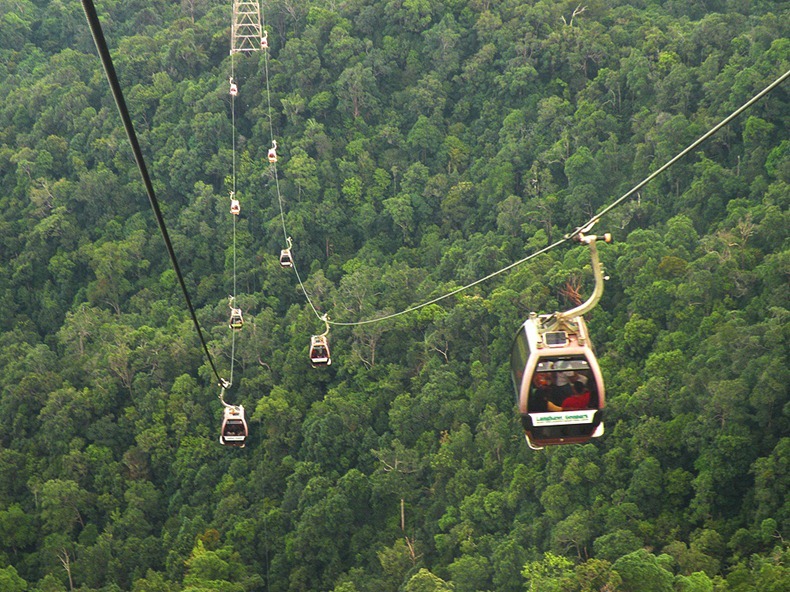
Langkawi Sky Bridge is a 125 meters curved pedestrian cable-stayed bridge, located at the peak of Gunung Mat Chinchang mountain, on Pulau Langkawi, an island in the Langkawi archipelago in Kedah, Malaysia. Completed in 2004, this suspended bridge is located at the ‘end’ of a cable car ride which begins at the Oriental Village at the foot hill of the Machincang mountain range. 

The bridge is suspended from a 82 meter high single pylon and hangs at about 100 meter above ground. It swings out over the landscape to give visitors a unique spatial experience and spectacular views. The 1.8 meters wide bridge has two triangular platforms that act as ‘stops’ where you can admire the view and rest your feet.
Langkawi Sky Bridge ranks among the world’s strangest suspension bridge and constructing it was not an easy feat. The entire bridge, in all its elements had to be lifted to the top of the mountain by helicopter and was later assembled to its current position.

langkawi-sky-bridge-5
langkawi-sky-bridge-7
langkawi-sky-bridge-1
langkawi-sky-bridge-2
langkawi-sky-bridge-3
langkawi-sky-bridge-9
langkawi-sky-bridge-10
langkawi-sky-bridge-6
langkawi-sky-bridge-11
langkawi-sky-bridge-13

Previous
Editor's Choice